Wednesday, January 31, 2007

Takayama Ramen and Goyei-Mochi in Hida-Takayama

Yesterday, I visited Hida-Takayama in Gifu prefecture, so I want to introduce about the city, Because of the city keeps some traditional Japanese style streets and it's very famous.

In additionally, the area is also famous in heavy snowfall in our area. So before going there with my friend who drove his car to Takayama city, we really worried about the road condition, you would guess that the road to Takayama is very easy to be covered with snow or frozen. But this year is very special year for Japan, this winter is very warm, so it's mild winter and we couldn't see any snow on the road. It's very strange.

Anyway, we really enjoyed sightseeing in Takayama, especially Takayama Jinnya that is a historical government house, the festival floats exhibition hall, traditional Japanese style and so on, and we took a lot of pictures when we found any interesting things. So I want to write about it few times, and this time is the first time and the content is about food.


The pictures are Takayama ramen. Japanese really love ramen and we can try a lot of kinds of ramen in Japan, generally the taste is depends on the area, so Takayama city has the taste that is soy sauce and chicken for making stock, and the noodles are fine. The style is very Chuka-Soba. The price is 650 Yen, it's bit cheaper than common price.


This picture is Gohei-Mochi. We ate it during walking around traditional streets. The Gohei-Mochi is a rice cake grilled with miso or soy sauce and it is a local dish in Gifu or Nagano prefectures. Sometimes we can find it in other area and I have some experiences eating it, and I've never felt tasty to be honest. But this time was difference it was so delicious. Maybe, we need to eat local dish in the area.


We can check the information about Hida Takayama!
Hida Takayama in Gifu

Friday, January 26, 2007

Matsushima is one of the most famous scenic places in Japan

There are the three most famous scenic places in Japan, which are Amano-Hashidate, Matsushima and Itukushima.

When I traveled in Tohoku area in November 2006, I also visit Matsushima! Matsushima is so famous in the fact that Basho Matsuo who was the most famous in Haiku couldn't compose good Haiku that is a Japanese poem of seventeen syllables.

Finally he gave up to compose his Haiku by the really beautiful great view.
So, his Haiku in Matsushima is...
Matsushima Ya,
Ah Matsushima Ya,
Matsushima Ya.

He just called Matsushima three times in his Haiku. Can you guess how beautiful it is?

So this time, I want to update some of my friend's pictures of the great view in Matsushima. Because of my battery of my camera had gone at that time.


Matsushima locates in Sendai gulf and there are a lot of small islands in the gulf, so the small islands make the special views.
And the there are a lot of pine trees on the island, the pine trees also help the special atmosphere to be very Japanese view. Because, pine tree is called Matsu among Japanese, and the tree is one of the important trees for Japanese, for example we make Kado-Matsu with pine trees to celebrate Shogatsu.


We took this picture on the island, and we can find a lot of the islands in the gulf.


And there is a red Japanese bridge after walking few ten minute, we are require to pay 200 yen to go across the bridge.


During waking across the bridge, we found the interesting thing. Can you guess what there are under the sea?

The answer is 'oyster'!

Because of Sendai gulf is so famous place in oysters in Japan.


After the bridge we walk around the island and took this picture. It was so fine day and we really enjoy sightseeing!

By the way, there are a lot of small shrines on the islands and the small shrines were tomb long time ago. We forgot picturing them! When we visited Yamadera in Yamagata prefecture, we also found such shrines. So I guess that the facts depended on the culture in Tohoku area. I'm interested in the common fact between Matsushima and Yamadera.


This picture was taken at the park on the island. We can watch the surface of the rook if we visit there at low tide.
It's easy to understand the rock scooped out since few thousand years ago! We also found some geologic stratums on the rock.


This is our lunch at that day!
We ate oyster rice, grilled oysters and oyster soup!
It was so nice!


When we walked around the red bridge, we found the place selling a lot of oyster and visited there. At that time, there are few small boats with a lot of oysters! It was very interesting and we talked with the fisherman about the mountain of oyster. But, we couldn't understand what he was saying by his very strong Tohoku accent.


After Matsushima, we visited very huge Buddhist temple that houses of the load of the domain of Sendai grave. The atmosphere was so nice, so I really want to post on my blog. But I couldn't take any picture with my camera whose battery had gone.

I study that it's very important to bring my battery charger of my camera with me when I travel anywhere.

Thursday, January 18, 2007

The Hasso is one of Japanese quasi-national parks in Inuyama-City

Last weekend, we went hiking in Hasso where is in Inuyama city that is our neighboring town. The area 'Hasso' is selected for one of Japanese quasi-national parks with the beautiful nature, so the area is bit famous for camping and really convenience to visit there from our town by a car.

So this time, I'd like to introduce Hasso and update some pictures took in the area.


This is the area map of Hasso in the campsite, and I took it to refer the map on my digital camera when we lost our way.

And in front of the map, we planed our hiking course that we could enjoy our hiking whole day, and the course had some beautiful areas, which were Hasso Falls, an observation platform, marshy areas, the Virgin Falls called 'Otomeno-Taki' in Japanese, the five stairs falls.


This is the Hasso Falls. It looked very simple, but it made a lot of fresh airs.

At first, we planed eating our lunch in front of the falls, but there weren't enough space. So we changed our plan to eat at the observation platform.


These pictures were taken at observation platform.
We can find the little world on a first picture. The little world is a theme park that has a lot of international building in the park, and we can't enjoy only buildings but also we can try international foods and costumes. We usually visit there by our school trips when we are elementary school students or junior high school students. At that time, I couldn't find any interesting things and just felt tired, but now it's very interesting theme park for me. Our senses would be changed by time easily.

This second picture is mt.Ontake.
We can find the shape of Mt. Ontake if it's really fine day in winter. Sometimes, our teachers said "We can see Mt. Ontake today" to us in our school. I think Japanese love some big mountains, for example Mt. Fuji, and Japanese sometimes love talking about them, I think that it's Japanese sense. Recently I like the sense little bit. I also changed by time in this point.

The third picture is Iruka Lake. Someday, I will write about the lake with sad and brave story. Because, the lake is so famous in our area.


Can you guess what it is?
I took this close-up photography at swampland, and the surfaces were frozen.
In my feeling, this swampland was the best in last our hiking.

And the atmosphere was like this!


Water came from left side and flow to right side on this picture and the width is 150 m and depth would be 1 cm.

And there are a lot of logs to go across the swampland, so people can walk on them. Some of them are bit old and decay, but they are still strong.


This picture are taken at the deepest point in the swampland, I guess that the depth would be three cm. We might understand that the swampland is so shallow.


On the other hands, we can find a lot of small stones over the water in the shallow place.

This swampland wasn't made with any rivers, it was made with spring came from the middle of the mountains, and the width of spring might be 200 m. The water is having came from long time ago, so the surface was cleaned and covered with small stones.

I didn't know such swampland is in Inuyama city.


After the swampland, we found the Virgin Falls and I took this picture.

Before the falls, we had to cross three log bridges, I don't want to go again by my fear of heights. Especially I bring my digital camera and cell phone with me, so I couldn't fall into the rivers.


Sometimes, we can find some falls and flows like this picture that I took during heading on five stairs falls.

At first, we thought that the falls were the five stairs falls by the fact we can count five falls, but it wasn't.


This is the five stairs falls! It's difficult to count the numbers on this picture.
In summer, some children would play with the falls.

This time, I enjoy the hiking in Hasso area in Inuyama city. There're some good views and falls that made us be interested in.
The area were very well-kept natures, and it's very easy to walk around and safe.

A lot of people usually enjoy camping in summer, but we can also enjoy hiking at a slow speed in winter.

If you're interested in Inuyama, please check more!
Inuyama City in Aichi

Wednesday, January 03, 2007

Hatsumode in Japan

A Happy New Year!
I wish you great success in the New Year!

This time, I'd like to introduce one of the most popular Japanese New Year Events called "Hatsumode" in Japan. Hatsumode is the event to pay our first visit of the year to a Shinto Shrine at New Year's.

So I also visited one of the biggest Shinto shrine "Naritasan" in Aichi prefecture and I enjoyed New Year countdown and Hatsumode! Both were my start of this year!

I took some pictures at that time, and I would like to show some of them on my blog.


This is the beginning picture and I took it on the approach to Naritasan at 23:30 in December 31st, 2006. The shrine is on the mountain, so we went up the stairs to the center of the shrine.
I took the picture at midnight, but there were a lot of people to go the shrine.


There is a Shinto shrine at the top of the stairs, and it was so crowded in front of the building of the shrine. The time, I was really lucky…because, I was in front of the building and it wasn't on the stairs in this year!


Suddenly some of the people started the countdown before the New Year and they prayed and returned. So we could move closer!


After countdown, everybody started to move to the front of the shrine, and then prayed.


In my case, my wishes are different every year and it depends on my situation. I'll try that my wish will be true in this year.


Finally, I would add a supplementary explanation. There are a lot of people praying at Hatsumode in Japan. But, most of them aren't pious believer in Shinto, and they prayed. So, the fact depends on Japanese culture.

If you are interested in the fact, you can read this homepage.
Religion in Japan

Tuesday, December 26, 2006

How did Samurai educate their children?

When I visited at Tsuruga Castle in Aizu-Wakamatsu, I found a one of the answers.

Because of the castle is a museum now, and we can touch some facts about Samurai's daily life and the history of Tsuruga Castle and so on. At that time, I was really interested in a practice of every child of Samurai.

So this time, I would like to write about the practice called Juu-No-Okite that is the rule of the group.

The children had to belong their group called Juu when their ages were from six to nine years old for entering their school Nisshin-Kan at their age of ten. So Juu-No-Okite was a rule of the group Juu that were small group of children and they usual played with the group.

And every evening, they recited the Juu-No-Okite and had a meeting for reviewing.

The contents were…

=========================================
1. Don't against what senior are saying.
2. We must make a bow for seniors.
3. Don't lie.
4. Don't act in a mean way.
5. Don't dully to any weak people.
6. Don't eat anything in the outside.
7. Don't talk anything with women in the outside.

And we can't do any forbad things.
=========================================

I think the rule includes two important means, first is looking up their seniors and two is helping weak people. Both would affect that they were be great leaders.

So, actually the Aizu-Wakamatsu domain was the most famous in valor. Because. Japanese valor should come with consideration for weak people.

Wednesday, December 20, 2006

Japanese Scarlet Maple Leaves at Jakko-In

I guess that it might be ten days ago. We had excursion for viewing scarlet maple leaves at the famous temple “Jakko-In” in Inuyama-City in North Aichi-prefecture. So, this time, I’d like to upload some of the pictures of scarlet maple leaves and the temple.

Inuyama-City is bit famous for tourist attractions, because the city has Japan Monkey Park, Meiji village and Little World, which are theme parks established by Meitetsu-Group. Every park is huge and interesting.
And there is Inuyama Castle that has a castle tower, which is national treasure on the rocky hill close by Kiso River.

The temple “Jakko-In” at Inuyama-city is so famous for scarlet maple leaves that there are a lot of posters in Meitetsu stations.

This time, I walked on the route that we passed through under Inuyama castle and go to Jakko-In to enjoy scarlet maple leaves, and then we visit the castle and came back with my friends.

From here, I would like to upload the pictures!


This is the tunnel under Inuyama-Castle. And Kiso River flows right of the picture. We would guess the area is the upper of Kiso River by the atmosphere of the rock.


I took the picture has a lot of scarlet maple leaves on the small brook when I walked to Jakko-In. There’re a lot of leaves.


The road to go the temple was colored by a lot of scarlet maple leaves. The timing when I visit was end of the season of scarlet maple leaves. So we walk on the road covered by a lot of fallen leaves.


The road is like this picture. The trees are scarlet maple leaves at right side.


So, these are the pictures that I took when I found a small path at right side. The steps also covered by scarlet maple leaves. I guess that it’s easy to slip at raining day.


I took the scarlet maple trees on the steps. So, there are just scarlet maple leaves!


There was a bronze statue after the steps. Of cause the background also scarlet maple leaves!


After the bronze statue, I guessed that it was the real beginning of the approach to Jakko-In. There were no autumn leaves on the steps, so I took the picture.


But, the scarlet maple leaves continued from next steps. We really loved the scarlet maple leaves. Don’t you think it’s beautiful?


These steps were under the roof made in scarlet maple leaves! The color was beautiful red at the foot, but the colors were changed to yellow! Because of the scarlet maple leaves are very sensitive in the environment, so there was a difference of temperature between the foot and top of the small mountain that Jakko-In locates on.


There is Jakko-In is a temple on the top of the mountain. And it has a special bell. How special? If we pray for our dream while striking the bell, the dream will come true. So, I struck it strongly! I wish the dream would come true.


And I took the picture of Inuyama-castle while going back. The left of the sun is Inuyama-castle, and the river is Kiso River.


Japanese really love scarlet maple leaves, and the leaves is one of the representatives of Japanese autumn. The atmosphere is difference from Canadian one. Canadian Maple leaves would be great and breathtaking, Japanese Maple leaves would be sensitive and breathtaking.

Because, Japanese beauties have been cared from old times and it was calculated.

Wednesday, November 29, 2006

The dolls of Chrysanthemum at Kasumiga castle in Nihon-Matsu city

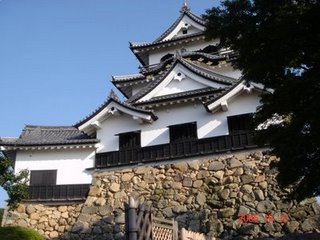
This blog is also written about my travel in Tohoku area. And this time, I would like to write about the event that is The Dolls of Chrysanthemum Festival called "Kiku–Ningyo" at Kasumiga castle in Nihon-Matsu city.


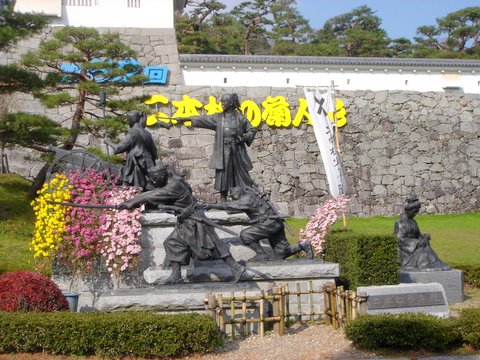
When we wanted to enter into the Kasumiga castle, we could found the bronze statues who died at the Boshin-war when they were so young. Generally the bronze statues aren't decorated with flowers, but the date was special.


And this is the entrance of the castle, and there is a long stone stairway in front of the gate. Can you find the two dolls on the stairway? They are so small on the picture.


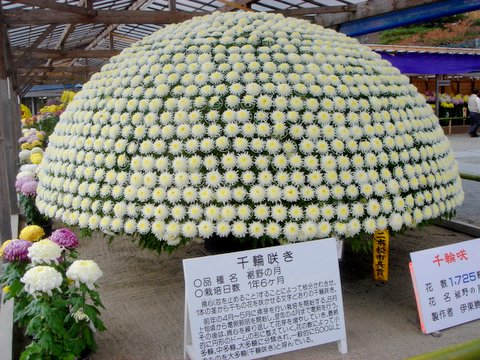
We enjoyed a lot of chrysanthemums in the castle. And the chrysanthemums is called "Sen–Rin-Zaki" that means "One thousand chrysanthemums". And the explanation about the chrysanthemums describe that the number is 1725. Wow, it's over one thousand!


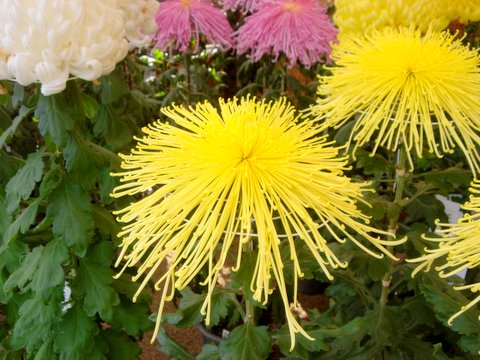
we enjoyed a lot of single chrysanthemums also. And this was my best chrysanthemum at the event. Is it beautiful?
But some of the chrysanthemums were already dead, and others didn't start flowering yet. Because, it makes everybody enjoy some of full-blown chrysanthemums over the term.


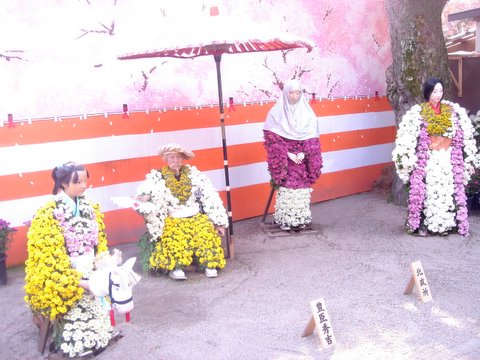
The theme of this year is "Komyoga-Tsuji" that is the famous period drama and the story is the success story of Kazutoyo Yamanouch who was a just soldier when he was young. But finally he became a King. So a lot of the chrysanthemum dolls show some scene in the drama. I can't remember the exact number of the scenes and it might be around 15.


So there were a lot of people on the drama in included Kazutoyo. And this scene is Hanami that is cherry-blossom viewing.


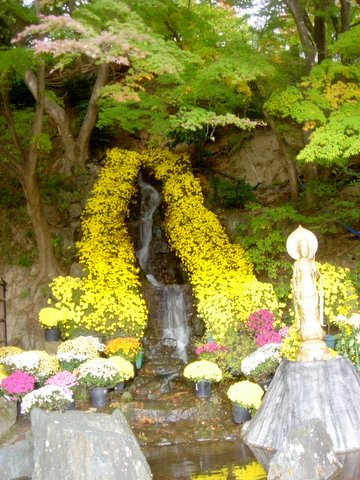
We enjoyed a lot of chrysanthemums all over the event included the drama. And the waterfall is also dressed with the chrysanthemums.


This is the biggest scene of the drama that is Sekigahara-war. The Samurai on the horse is Kazutoyo. Maybe you can see that the dolls wear the chrysanthemums.


After the drama, the atmosphere was changed to Japanese story of olden times. And the picture is "Sichi-Fuku-Jin" that is the Seven Deities of Good Fortune.
If we see the picture carefully, we can find the autumn leaves.


We found the doll that is changing the chrysanthemums and we went near the doll and took the picture. And we found the fact that general people can try the change with our reservation.


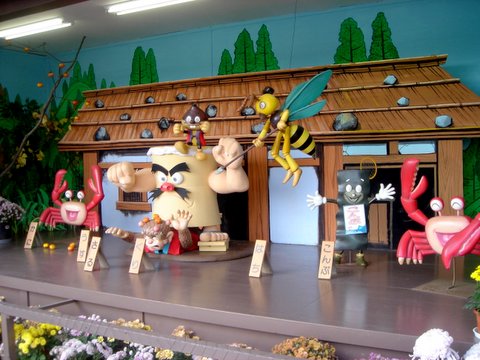
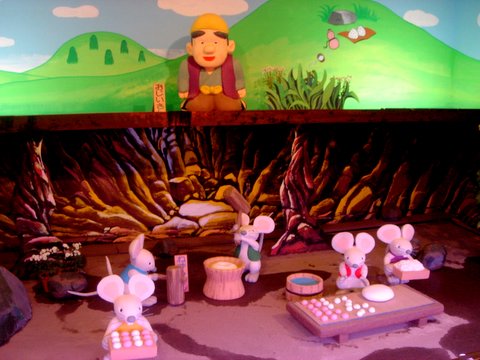
These pictures are Japanese story of olden times. Someday, I would like to describe the stories.


This isn't Japanese story of olden times. And is a puppet show that describes a woman who fights with her incurable disease and her name is Chieko. They also wore chrysanthemums.


I took the picture on the hill after went out from the event. We could see the whole place of the event. This side is the scene of the Sekigahara-war, can you remember?


We enjoyed the chrysanthemum doll festival so much. And the festival is unique for me.
When I visited some places in Tohoku area. I found the fact that they really love their local famous people. It's bit difference from other country's one.